I found through the San Jose State University, they are offering this class for free with Alejandro Garcia.
When you are wondering what to watch on TV tonight, don't. Instead start this class, to attend click here.

Thursday, April 30, 2015

Dealing with procrastination; the downfall of the Animator
Why is procrastination such a heavy burden for creative people?
There is several reasons;
- You set the standard to high without a way or the path of achieving it.
- You have created high quality of work and you are scared that nothing else is going to measure up.
- You are just scared of failure.
- You are scared that the commentators/critiques are there because you have failed.
- You set yourself such a tight deadline not even a supermodel could fit in and so therefore you didn't get it done.
- You want; an original idea, motivation or inspiration. Sorry darlings, the original ideas have already been thought and the motivation or inspiration have to be self driven journeys.
- Everything you have made this week/month/year you consider as junk.
- You always work on something "safe". Something that you know how to animate already.
I could go on but you see that the one thing that ties these things together are the FEAR, the way that you deal with how you will not be the same as anyone else and how you hide when you get to the point of FAILURE. The only way that you could measure if something is a failure or a success is ONLY YOURSELF!
There is many times that you are not going to be able to measure yourself independently from your ego as an artist and distance yourself from your art. That's OK, it takes time to move from the idea that everything you create is precious and you will get another gold star or pat on the back because you have created it. The only way to improve is to override the fear of whether success or failure that you have intentionally written in your brain is going to be the outcome and create a large body of work.
Don't stop doing, asking, question and thinking. If it is going to make you accountable get yourself deadlines for your own work and let go of tweaking it after you have finished. Use other people even if they are not animators to view your artwork when you feel to close to the product since your eye will get skewed and you will not take the brash leaps to correct what is glaringly wrong without people pointing out to you.
A lot of animators have accounts on forums or post on a blog so make sure you even if you are scared, post/submit even the ones that you feel that you ruined and take comments with a grain of salt. I used to blue tack up the comments from other people and used to remind myself of how they wanted me to improve.
Don't overdo, we animators tend to work very hard and do not take breaks! So after 6 hours or more staring at a moderately small screen, moving keys and straightening out the overshoots in graph editor you eyes are going to start feel strained and you are slowly pushing yourself on path to RSI or carpal tunnel. Take a break, get away from the computer! Learn some stretches for your hands and go and take in nature or look at what other people are doing. Get out of the office at lunch and spend time people watching even when you get home (Walt Stanchfield used to draw quick poses off what he saw on the TV, either while watching dramas or sports).
So happy mid week, keep on Animating!
Cassie
Thursday, April 23, 2015
How does a human fall?
Gravity tens to be a harsh mistress, once the body is off balance and is not going to be able to recover we do only one thing, Fall.
So why am I teaching you about falling? well if we are not standing in place indefinitely we are all falling be it walking, running, sitting down, non controlled falling (tripping, lose balance) and then controlled falling (dropping to the floor on the knees, planned place to land).
Torso governs movement, the hips control the directional movement of legs and the shoulders control the direction and swing of the arms. The chest governs posture and lean and the different between the sheaths of muscle holding the stomach and the spinal cord and the rib cage which is flexible to a point but is rigid in that if you move, the rib cage holds its shape.
One of our senses is our sense of balance, how we stay up. When our seeing and hearing does not match up, you have problems with balance (people with vertigo have a sensation of the ground getting magnified but their ears telling them they are up higher than what they see, resulting in feeling a little bit dizzy). When our weight cannot stay on balance, we cannot counteract the pull of gravity and we have to fall.
There is a difference between controlled falling and uncontrolled; the brain knows that it is falling it doesn't come as a shock that you are falling. Walking, the body catches itself on the next step. Running the body encounters one foot hitting the ground in the pass through, the body has to stay on balance with one foot.When you need to fall, sitting or other ways (in stunts, martial arts and in acting) you are conscious of not trying to protect the body while falling. You fall the right way, you don't' throw your arms up to catch yourself or towards the ground to brace the impact through your arm. You are limp and relaxed not tense and like a plank.
Next time you are watching a scene in a movie, watch the stuntmen falling/rolling on the floor, also notice the drawn out dying scene and at least once in most of these movies someone sits down in a chair. Notice how people negotiate with their bodies the idea of falling with doing it on purpose. Or you can always notice in the usual funny videos on YouTube for non-controlled falling.
Until, next time happy animating!
Cassandra
So why am I teaching you about falling? well if we are not standing in place indefinitely we are all falling be it walking, running, sitting down, non controlled falling (tripping, lose balance) and then controlled falling (dropping to the floor on the knees, planned place to land).
Torso governs movement, the hips control the directional movement of legs and the shoulders control the direction and swing of the arms. The chest governs posture and lean and the different between the sheaths of muscle holding the stomach and the spinal cord and the rib cage which is flexible to a point but is rigid in that if you move, the rib cage holds its shape.
One of our senses is our sense of balance, how we stay up. When our seeing and hearing does not match up, you have problems with balance (people with vertigo have a sensation of the ground getting magnified but their ears telling them they are up higher than what they see, resulting in feeling a little bit dizzy). When our weight cannot stay on balance, we cannot counteract the pull of gravity and we have to fall.
There is a difference between controlled falling and uncontrolled; the brain knows that it is falling it doesn't come as a shock that you are falling. Walking, the body catches itself on the next step. Running the body encounters one foot hitting the ground in the pass through, the body has to stay on balance with one foot.When you need to fall, sitting or other ways (in stunts, martial arts and in acting) you are conscious of not trying to protect the body while falling. You fall the right way, you don't' throw your arms up to catch yourself or towards the ground to brace the impact through your arm. You are limp and relaxed not tense and like a plank.
Next time you are watching a scene in a movie, watch the stuntmen falling/rolling on the floor, also notice the drawn out dying scene and at least once in most of these movies someone sits down in a chair. Notice how people negotiate with their bodies the idea of falling with doing it on purpose. Or you can always notice in the usual funny videos on YouTube for non-controlled falling.
Until, next time happy animating!
Cassandra
Monday, April 20, 2015
Why to not or to offset keys is the wrong question to ask.
Hi Everyone,
Now this is a little bit controversial, we have always been told to either offset them or not.
Now really in the the major keys (golden poses) most of the movement hits the beat. This is where all your keys should be together or at least one or two frames forward or backward from the pose. This is where you really need to get into the habit of fleshing out your storytelling poses before getting into the animation program.
Try to figure out not just arcs (since the body will always arc since that's the way the body is designed) but how movement affects secondary movement, it's not separate and secondary movement is not always the follow through of the primary movement.
The body shifts and and limbs are always going to offset in the breakdowns because the movement looks wooden if you have everything move at the same time or you have not accounted for overshoot or extremes (this doesn't mean cartoon style action, just look at a slow motion video of someone punching a guy or throwing a ball).
If you tend to keep exaggerating with just pushing the movement in the way it was flowing it is then going to look floaty and you also going to miss your beats, people! So try to keep that in mind. The reverse is always true if you try to always get the poses to pop then you can end up to overuse this affect and it will then turn into jerky and you will come in short with your beats (since the mind of the audience needs time to read the action, that is why moving holds were invented) the beat is just going to need to hit and then slightly stay on pose before the next pose.
Since the mind is always like this: Action-Reaction-Anticipation-Action. We are designed to capture at 24 frames per second, we read action at 12 frames second, we react to about 6-8 frames per second and we might consider 4 frames important unconsciously . That doesn't mean that the brain is lazy it just has to deal with constant feedback and it tends to focus on fast movement, hands (gestures) and the face (emotions and eye movement).
Maya or max are really, really lazy inbetweeners and sorry you will never get to fire them and hire a better inbetweener. That means that when offsetting try to leave at least some idea of what is what (not just key every single frame) so when you need to go into the graph editor it's not like someone has tried to make spaghetti in it. When looking at the program that your animating with tend to go with the perfectionist stream of thinking if it doesn't look right then it's not right, why it's not right you have to really work that out quickly before you go onto your next pass or next set of keys.
When looking at video capture, spend time not by drawing poses but by real analysis of why the movement is like that, what is it telling you. Figure out how gravity is either assisting a movement or not assisting the movement. The mass of the body and how it is affecting the movement.Thinking is what we need to do always as animators, animation is not blind luck it's about carefully controlled elements to produce amazing likeness of real flesh and blood movement.
Thanks for reading, happy animating!
Cassie
Now this is a little bit controversial, we have always been told to either offset them or not.
Now really in the the major keys (golden poses) most of the movement hits the beat. This is where all your keys should be together or at least one or two frames forward or backward from the pose. This is where you really need to get into the habit of fleshing out your storytelling poses before getting into the animation program.
Try to figure out not just arcs (since the body will always arc since that's the way the body is designed) but how movement affects secondary movement, it's not separate and secondary movement is not always the follow through of the primary movement.
The body shifts and and limbs are always going to offset in the breakdowns because the movement looks wooden if you have everything move at the same time or you have not accounted for overshoot or extremes (this doesn't mean cartoon style action, just look at a slow motion video of someone punching a guy or throwing a ball).
If you tend to keep exaggerating with just pushing the movement in the way it was flowing it is then going to look floaty and you also going to miss your beats, people! So try to keep that in mind. The reverse is always true if you try to always get the poses to pop then you can end up to overuse this affect and it will then turn into jerky and you will come in short with your beats (since the mind of the audience needs time to read the action, that is why moving holds were invented) the beat is just going to need to hit and then slightly stay on pose before the next pose.
Since the mind is always like this: Action-Reaction-Anticipation-Action. We are designed to capture at 24 frames per second, we read action at 12 frames second, we react to about 6-8 frames per second and we might consider 4 frames important unconsciously . That doesn't mean that the brain is lazy it just has to deal with constant feedback and it tends to focus on fast movement, hands (gestures) and the face (emotions and eye movement).
Maya or max are really, really lazy inbetweeners and sorry you will never get to fire them and hire a better inbetweener. That means that when offsetting try to leave at least some idea of what is what (not just key every single frame) so when you need to go into the graph editor it's not like someone has tried to make spaghetti in it. When looking at the program that your animating with tend to go with the perfectionist stream of thinking if it doesn't look right then it's not right, why it's not right you have to really work that out quickly before you go onto your next pass or next set of keys.
When looking at video capture, spend time not by drawing poses but by real analysis of why the movement is like that, what is it telling you. Figure out how gravity is either assisting a movement or not assisting the movement. The mass of the body and how it is affecting the movement.Thinking is what we need to do always as animators, animation is not blind luck it's about carefully controlled elements to produce amazing likeness of real flesh and blood movement.
Thanks for reading, happy animating!
Cassie
Sunday, April 12, 2015
12 Principles of Animation by Alan Becker
We all have to brush up the basics every now again, or at least check back.
Have a very happy Sunday, keep animating!
Cassandra
Tuesday, April 7, 2015
Believing in you - Are you happy right now?
There are known knowns. These are things we know that we know. There are known unknowns. That is to say, there are things that we know we don't know. But there are also unknown unknowns. There are things we don't know we don't know.
Donald Rumsfeld
The loud speaker crackles "animator 3106 ; please step forward" you hasten to the front of the line to get paid your dues, for all that time spent training and animating your little heart out. You get a cushy job doing something you like getting an awesome wage and with people that will like you and you will get along with.
Wouldn't that be nice?
If the world at the end noticed how hard you were working. Not just working at another job that does not pay to be creative, doing less than two hours a week animating on the side. Not up there with a resume in hand, the show reel in the other and a personality that said "hire me quick!" stamped on the front of your face so much so it leaves a impression on people.
I love one of Bon Jovi's songs "welcome to wherever you are" which has the following lines as chorus;
"Welcome to wherever you are
This is your life, you made it this far
Welcome, you gotta believe
That right here right now, you’re exactly where you’re supposed to be"
We believe so much in getting passive feedback about how we are progressing that we forget to do the stuff that matters to ourselves. We in the end believe we are only as good as that job that pays our bills and for our crap, forgetting that we are only happy when we are creative by ourselves or with other people.
Now do you believe that you could do better? be a better person and a better animator? If you push to achieve then you will always get there in the end, no success story is without struggle.
Thank you. Until next time, Happy Animating!
Cassie
"Around here we don't look backwards for very long. We keep moving forward, opening up new doors and doing new things, because we're curious...and curiosity keeps leading us down new paths." Walt Disney
Saturday, April 4, 2015
Artistic dilemma or ESP? Why animators are not usually good storytellers.
Good news first, I am going to be writing some brilliant articles as a guest over at Animation Salvation for DJ Nicke. Which I'm looking forward to when I finish them and of course I will link them over here so you can peruse them over there at your leisure.
In the process of writing them, the internal dilemma stepped in and kicked me neatly in the face. Most of the posts here that have had traffic from other sites have been the anatomy ones and those are the ones I will be writing more in depth over at Animation Salvation.
Animators do not need knowledge of physiology or clinical medicine, nor the memorization of so many muscles in groupings that it makes your brain fall out your ears and make your eyes bleed. Sorry for that last mental picture, but you know.
We live for stories and for the simple explanations for many more complicated answers as Eisenstein said “If you can't explain it to a six year old, you don't understand it yourself.”
The problem with the creative mind is that it mostly assumes that it can explain things the way it wants to and that everyone is going to get it;
This is what we do with stories cram them full, since everyone loves details right? We want to put all our ideas forward like precious new babies wrapped in bubble wrap that no one will break. We make the story confusing, muddled in the unnecessary.
Most of the most the powerful stories can be told in the same space of time as knock-knock joke, not that you want to. We remember the things that identified with us as individuals, love, betrayal, guilt, loss, grief and being happy. We are primary driven by emotions, the conviction that we are feeling is right and most of us are empathetic with others that are showing emotion.
To sum up, we need and crave simple. The comfort food for the soul is stories and people that can play in tune with the heartstrings.
So happy animating, til next time!
Cassie
Thursday, April 2, 2015
Understanding the magic of FLOW
You have heard of flow right? The mystical magic of this far fetched creative state that makes you so concentrated that you lose track of time and just focused on the task at hand.
We live in a "now" state, now, now, now. Checking phones, watching the clock counting down the end of the day and procrastination until we run of the time. One of the fun things I have heard, do a task for 2 minutes if you want to quit after 2 minutes then do it (but usually you never do). Also take breaks do a task for 25 minutes, stop for 10/15 minutes and then get back to it (which I would suggest since animation tends to be RSI heavy and you really need to look after your wrists if you want to animate without pain). Flow tends to move between states that you are in and then out, So you need to not push it because it doesn't come to the front while trying to force it (like going to sleep).
There is a post over at Daring to Live Fully on how to enter a flow state
Pay more attention to tasks.Take time to actually clear the mental clutter that might look like a walking, bouncing, junkyard. Breath (yes, yes, of course you breath or you die) I mean Breathe as in, 6 counts in, 5 counts out.
Don't think that you have no time to develop one major skill that you need as a Animator.
Happy Animating!
We live in a "now" state, now, now, now. Checking phones, watching the clock counting down the end of the day and procrastination until we run of the time. One of the fun things I have heard, do a task for 2 minutes if you want to quit after 2 minutes then do it (but usually you never do). Also take breaks do a task for 25 minutes, stop for 10/15 minutes and then get back to it (which I would suggest since animation tends to be RSI heavy and you really need to look after your wrists if you want to animate without pain). Flow tends to move between states that you are in and then out, So you need to not push it because it doesn't come to the front while trying to force it (like going to sleep).
There is a post over at Daring to Live Fully on how to enter a flow state
Pay more attention to tasks.Take time to actually clear the mental clutter that might look like a walking, bouncing, junkyard. Breath (yes, yes, of course you breath or you die) I mean Breathe as in, 6 counts in, 5 counts out.
Don't think that you have no time to develop one major skill that you need as a Animator.
Happy Animating!
Wednesday, April 1, 2015
Looking at style not process- the hiccups of the student
I should back this up with a little back story: I went to a screening of of a beautiful animated movie (Secret of Kells) with an old animation colleague (we were students together) and his students from the same course that we both took back in the day (not that I'm old mind you).


I noticed even afterwards the students took away the styling which seems odd, as apparent as the nose on your face. Styling is only there to further storytelling:
(for example in "Who framed Roger Rabbit?" Bob Hoskins was addressing a wall and forgot how small the rabbit was. They only had a small time to get the movie out and so they really couldn't shoot that piece again. They decided since the rabbit is clearly paranoid that they could squash him against the wall therefore increasing his height twice fold.)

I really did enjoy the detailing, but I noticed that the colours were there to show the dramatic or calm scenes. The difference in height of the characters meant that you could see the power play at work before they even spoke, even the different nationalities meant even when they were pushed together on screen they didn't get lost. Also the detail in the framing of the shots meant that the viewers eyes get directed to the middle of the screen. I really liked the animation on Pangur Bán (the cat) as in that usually with quite stylised animation usually style wins over trying to show character or extremes of movement.
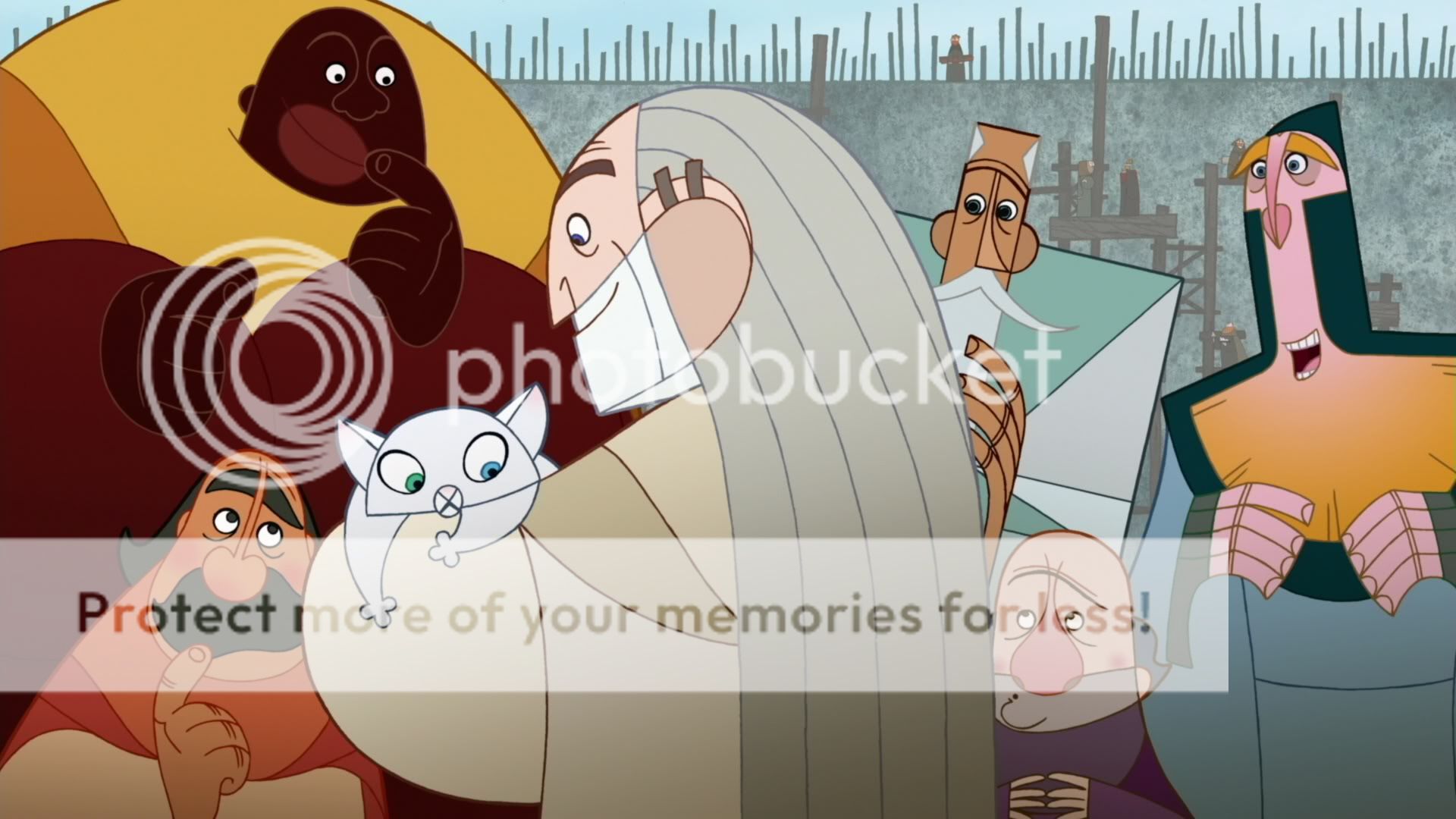
But I digress, Style is not process; nor is something that will win you a lot of marks (only animating "anime" style is not going to get you a job in anime since it's only the way you animate that matters). Style holds hands with how good you are as a storyteller, coupled with how good are you as a mimic/copycat/actor. You still have to show personality, give a reason to be empathetic with "your" characters and understanding that the audience needs clear idea of the concepts or the story to follow the story that you are trying to portray.
Too long do students play with the idea of styling, cameras and lighting. Scaring them in to a complacent role in their "job" of animating;
- So much so that they don't start story-boarding/capturing live action early enough,
- Rush through the first key defining aspects of tying down the animation to animating one week before deadline,
- Do not give themselves the leeway of throwing the whole animation away if they don't like it (for whatever reason) or starting back from whatever save that they are happy with
- Do not give themselves a couple of hours (or day/s of playing with the scene to push the concepts/body language/personality) to tweak what is already looking non fluid and muddy,
- Have no concept of the arcs and beats being something that should be planned in story-boarding/penciled dope sheet
- Then hand it in with a attitude that "It was all I could do in that allotted time frame" without realising that they have in themselves essentially made the process/workflow a lot harder for themselves and also sabotaging getting themselves a career in a very competitive industry.
This is not to say that anyone/everyone is not free of this and this is why animators are so interested in other animators workflows or animation techniques to make sure that they don't get caught up in the self perpetuating cycle of doom ("why I am I doing this/everyone is better animating than me/my animation looks crap or I didn't have enough time to finish/such a failure no good animator") .
If you are a student or starting animating, I am not attacking you personally and this is a perspective that I see, being a "non-student" of animation for quite a while now (doesn't mean that I have stopped learning or stopped not loving an art form that is amazing even in this day and age). All I am trying to say to you is if you haven't got to the stage of not repeating the steps above then break the cycle, it's not a fun place to be in (I know) and that's why I'm trying to help you.
Until next time, Happy animating!
Cassie
Wednesday, February 25, 2015
Behavior; is not about just swinging arms.
Life is the reality of contrast and physics that holds things together.
Think/Feel-Act-Process (Think/Feel)-Reaction.
Does not matter if it's something that does not rely on conscious thought (Behavioral Scripting, I.e. doing something over and over again until it just becomes commonplace for example most adults will be able to have or make breakfast while doing other activities such as talking or reading a book/newspaper without too much trouble). Although it's funny to watch people learn a new task when they are still clumsy and non-adept at it (Slower, more concentration, procrastination of starting the activity and more emotional task).
What happens if you start moving arms and legs around in a vain attempt to show that a character is "alive"? Might as well be showing a magic trick while still memorizing the trick out of the book.
Humans are emotional critters at the very best and very worst of times. We tend to act on our feelings or instinct even before it comes known "the why" the process has been triggered and a lot of people go with the feeling even after it becomes apparent that it's not rational.
Overcoming or even realising basic programming from fight/flight or noise/movement can be very hard. You know the feeling at a party when someone makes a loud noise and you are suddenly switching your attention to follow that someone's actions and then realise with some guilt that you have tuned what the other person (that you were talking to) has been saying to you for about a minute? Or that feeling like you really, really want to punch your boss?
We need to identify, empathise and feel real emotions for us to really connect with anything that is seen to be "living" especially if it is seen to be human or humanoid. Anything other and it will be seen as scary, non life like and very much uncanny valley.
We really do not swing our arms unless in the following situations: We are really trying to get someone's attention, in the last reaction of slowly falling of a cliff in a vain attempt to grab something, we want people to think we are crazy. Or swinging legs unless; doing a really long march, really wanting to show off shoes/happy attitude/direction of the pub or a comic on stage.
Mostly a lot of our action is really rather small in economy (well, I don't want to seem crazy, do you?). We don't tend to exaggerate our actions unless we feel quite strongly or telling stories.
That means that the whole story telling poses are trying to show to the max range of the character through the dialogue/movement phase is all you got (take into account where the character has been raised, body size/shape/weight, male or female not just in the sense of body structure but also gender biases, even what does they do in their spare time to unwind/connect/feel better about themselves).
A lot is said in the way people do things (how many times have you just looked at a person and just have a impression of them as a whole?) Now we are pushing the idea this empty vessel (the character) is a normal person with hopes, dreams and fears.
I know, I did kinda rant but in someways. You guys "know" this already don't believe in moving an empty vessel around the stage (that's being a puppet to another puppet). This vessel is you in someways as well (like all art forms, you cannot express what you do not know yourself) have fun! Don't let the task become the be all and end all, know that if you are just moving it for the sake of moving it than that is not animation.
Happy animating,
Cassie
Think/Feel-Act-Process (Think/Feel)-Reaction.
Does not matter if it's something that does not rely on conscious thought (Behavioral Scripting, I.e. doing something over and over again until it just becomes commonplace for example most adults will be able to have or make breakfast while doing other activities such as talking or reading a book/newspaper without too much trouble). Although it's funny to watch people learn a new task when they are still clumsy and non-adept at it (Slower, more concentration, procrastination of starting the activity and more emotional task).
What happens if you start moving arms and legs around in a vain attempt to show that a character is "alive"? Might as well be showing a magic trick while still memorizing the trick out of the book.
Humans are emotional critters at the very best and very worst of times. We tend to act on our feelings or instinct even before it comes known "the why" the process has been triggered and a lot of people go with the feeling even after it becomes apparent that it's not rational.
Overcoming or even realising basic programming from fight/flight or noise/movement can be very hard. You know the feeling at a party when someone makes a loud noise and you are suddenly switching your attention to follow that someone's actions and then realise with some guilt that you have tuned what the other person (that you were talking to) has been saying to you for about a minute? Or that feeling like you really, really want to punch your boss?
We need to identify, empathise and feel real emotions for us to really connect with anything that is seen to be "living" especially if it is seen to be human or humanoid. Anything other and it will be seen as scary, non life like and very much uncanny valley.
We really do not swing our arms unless in the following situations: We are really trying to get someone's attention, in the last reaction of slowly falling of a cliff in a vain attempt to grab something, we want people to think we are crazy. Or swinging legs unless; doing a really long march, really wanting to show off shoes/happy attitude/direction of the pub or a comic on stage.
Mostly a lot of our action is really rather small in economy (well, I don't want to seem crazy, do you?). We don't tend to exaggerate our actions unless we feel quite strongly or telling stories.
That means that the whole story telling poses are trying to show to the max range of the character through the dialogue/movement phase is all you got (take into account where the character has been raised, body size/shape/weight, male or female not just in the sense of body structure but also gender biases, even what does they do in their spare time to unwind/connect/feel better about themselves).
A lot is said in the way people do things (how many times have you just looked at a person and just have a impression of them as a whole?) Now we are pushing the idea this empty vessel (the character) is a normal person with hopes, dreams and fears.
I know, I did kinda rant but in someways. You guys "know" this already don't believe in moving an empty vessel around the stage (that's being a puppet to another puppet). This vessel is you in someways as well (like all art forms, you cannot express what you do not know yourself) have fun! Don't let the task become the be all and end all, know that if you are just moving it for the sake of moving it than that is not animation.
Happy animating,
Cassie
Tuesday, January 27, 2015
Truth about the rule of thirds, symmetry, repetition and rhythm
I know that the actual talk is focusing on photography but the actual topics discussed are not just composition rules but are about the idea of "what the eye/brain likes and does not like" which is as important to Animators as it is to any other visual medium.
Thursday, October 23, 2014
Fosse - what are you missing?
Robert Louis “Bob” Fosse (June 23, 1927 – September 23, 1987) was an American actor, dancer, musical theatre choreographer, director, screenwriter, film editor and film director. He won an unprecedented eight Tony Awards for choreography, as well as one for direction. He was nominated for an Academy Award four times, winning for his direction of Cabaret. Introduction to Bob Fosse
Now, hopefully you did watch the videos. Now what are you missing?
Bob should of been an Animator, the silhouettes are precise, the timing is beautiful (doesn't need the music to still show attitude). The stories, the women: are portrayed as different, not just as props to further the movement of the dance but as in the attitudes that are shown. Exaggeration comes naturally to the "stylized" performance.
What you can learn from Fosse? That movement is meaning and attitude is life.
Inspired by the musical, choreographed by Rob Marshall.
Thank you and to next time, happy animating.
Wednesday, April 30, 2014
Dynamic Bodies

Hi All,
I was thinking today how people approach a something alive. The first mistake that most animators make when approaching something that has a skeletal structure is they treat it like a exoskeleton which makes no sense at all. Rigidity is the enemy of animation or an artist, thinking because it has a skeleton it does not move this way ("because I think it doesn't") is the first thing that will kill animation.
Let me explain to you, we are not made out of boxes even in something like armour we still able to flex and move (yes, restricted movement.. but still movement). So if I pushed the person wearing armour flat to the floor they will struggle to get up but they will still be able to try and get up. Amazing is the skeletal structure, let me say that it is a wire frame it just gives us the ability to use the elastic bands (muscle) and hinge or swivel system that has been built into the wire frame. This means that we use the force of gravity for our own gain, in that we are always using the musculoskeletal system in this way.
Walking is controlled falling, actually all of our activity has something to deal with conterracting or been assisted by gravity. One side of the bone the muscle contracts and the other it it extends to keep us balanced and so we do not fall. That means extreme movement for any of living skeletal organism, that means other than the bones making sure that muscles stay in place and that we don't get crushed by our mass by gravity this is true. That muscles deform around the structure making sure that it protects and gets the most out of movement.
Believing that "rigidity" is only there because you believe it to be true and trying to counteract the feeling that "I can't do this because the 3D model is not designed better" well, that is just excuse. Animators in the industry if they don't get what they want out of a rig, they don't go and see the people that made it to blame them for their animation. They save the scene and then try to break the rig into what they want. Only in some of the best studios will you get a fully animatable rig with bones for every part of their face so don't dream that it is a standard. Or that people can't do that, well unless you prove it to me with reference not going to believe you it's only in your head, because you feel that you cant do that does not mean that people can't do it or that they do all the time. Or that your scared of what the 3D program might think of you, well if your scared of a program that is just there to inbetween your keys then your are very timid person.
That means also is that you can push things, your an animator right? other than stuff that looks unnatural because you have forgot hinges or swivels and how they react. The rest of it fair game make things move the way that you style them to be, animation is an artistic form and that does not mean that you can't push something to the extreme artistically with only the realism to make things work.
Believing that something is there to be a lazy animator, to turn off the "what happens if" and not expanding the understanding and comprehension of how or why things move or why something looks so pleasing to you. Then please just understand that your not a bad animator, but you have not given yourself the chance to become a good one.
Thankyou for reading, until next time. Happy animating!
Monday, April 7, 2014
Inspiration - Looking into storytelling

Hi all, Inspiration for the following week.. Both Pixar and Hayao Miyazaki, have shown their takes on storytelling and film making. The 22 rules of Storytelling according to Pixar and the 6 Film Making tips from Hayao Miyazaki (the latter link found on the Facebook page, Animation Garden - which is run by some amazing Animators. Frank Gaschk and Ian Lacey, please do hop over there, like and follow for some amazing links).
Great Interviews with great animators such as Kiel Figgins and Sandro Cleuzo and more, so pick up inspiration from the big time over at AnimDesk.
The last one is Mark Meyerson's Blog on the Art and Business of Animation
After all that reading, time to crack down and animate, yes?
'Til next time, stay happy and keep Animating!
Cassandra
Thursday, April 3, 2014
The road less traveled- why failure is so important?

“You build on failure. You use it as a stepping stone. Close the door on the past. You don’t try to forget the mistakes, but you don’t dwell on it. You don’t let it have any of your energy, or any of your time, or any of your space.” Johnny Cash
Why are creatives so scared of failure? You have to deal with it, success comes only to the select few that have fought with their constraints (only you make your constraints no one else does, if someone came up to you on the street and said "only animate this certain way, would you?". No of course not). Failure is not something for you to be scared about it just means that you chose to extend your artwork and yourself in the pursuit of being a better artist.
You will fail (alot) and you have to be willing to show these failures to people that will tell you why you failed. Do not cover them up or make excuses (please, please don't do this, means that you have no faith in your artwork or your skills. If this is the only thing that comes out of your mouth then you might as well not try because when people offer critique you will not heed it) and don't run to the people that will give you compliments because you will not get any better while you listen to people singing praises (your productivity will slack off and you will not see the people that are much better, that will inspire you to get better). Learn to deal with the brute honesty and hold those people close the ones that take the time to help you become better at your craft. Learn and use that knowledge and take the knowledge that you can get free of charge from other animators, artists and the public.
Don't be afraid to show your work, you worked very hard on it and it should show and take any opportunity that you have to work more, to make the quality better with increasing your speed and to show it off in competitions, galleries, screenings for friends and family, your network of colleges (that are willing to see it and give feedback).
Take time to notice life, catch it, express it, learn more about it, people watch, take pencils and paper and sketch when you can, if you have a device (tablet or laptop) pay the money and get flip-book, learn where you can collab, sketch crawl and life drawing, take the time to learn a different form of artistry.
MOST IMPORTANTLY LEARN AND FAIL LOTS :) only way to expand as an Artist.
Thank-you for reading and 'til next time Keep on Animating!
Cassandra
Monday, March 31, 2014
An interesting addition to body mechanics of emotion

Found this research on different areas of the body showing heat related temperatures compared to the emotion. Found on Life-Hack click here for the whole article
Tuesday, February 11, 2014
Understanding the structure underneath; why take the skeleton into account.

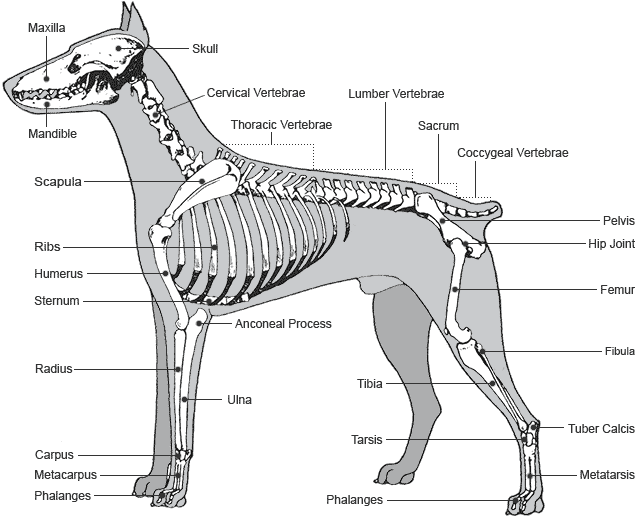
Ball and socket joints: rotate until constrained either by the pelvis or the shoulder blade and clavicle.
Hinge joints: arc until constrained by the particular end of the joint which locks into place and does not allow over movement.
Vertebrae: is held in place by sheaths of muscle i.e. torso and neck which keeps the vertebrae in place while allowing the column to pivot.
If you want more study into the Anatomy of the Muscles of the Head and Neck check out the lecture by John Simmons only 7 minutes long, well worth watching for any animator. Click Here
Friday, February 7, 2014
Some late week, Animation Inspiration
Some lovely and very simple animation from Studio Ghibli
The making of The Bear and The Hare
Also I have to include this, it nearly made me cry. Wise words from Amelia Lorenz on the Animator Letters Project.
"One other thing that I sometimes remind myself- storytelling is a way of bringing people together, and it can be a way of healing sometimes. So animators may not be like police officers or fireman or doctors, in the traditional sense, but I believe as storytellers we can be like doctors for the human spirit. We can show that the world can be beautiful, that people can learn and grow, and that life can be pretty cool. We can be like the cheer-leaders of the human race! So that makes me feel good, even though “all I do” is draw. I try to draw for good reasons. It seems like as long as I enjoy what I do, and others enjoy it too, then it’s worth it." To see the whole letter
The making of The Bear and The Hare
Also I have to include this, it nearly made me cry. Wise words from Amelia Lorenz on the Animator Letters Project.
"One other thing that I sometimes remind myself- storytelling is a way of bringing people together, and it can be a way of healing sometimes. So animators may not be like police officers or fireman or doctors, in the traditional sense, but I believe as storytellers we can be like doctors for the human spirit. We can show that the world can be beautiful, that people can learn and grow, and that life can be pretty cool. We can be like the cheer-leaders of the human race! So that makes me feel good, even though “all I do” is draw. I try to draw for good reasons. It seems like as long as I enjoy what I do, and others enjoy it too, then it’s worth it." To see the whole letter
Want to be an Animator? Go fish.
Intriguing little post form the Animator Island blog. Go fish?
Learn to be a better animator by being a better person, you cannot hope to learn about movement and other humans by staring at a wall. Go and become better, until next time Happy Animating.
Learn to be a better animator by being a better person, you cannot hope to learn about movement and other humans by staring at a wall. Go and become better, until next time Happy Animating.
The Animation light-bulb. Part 2 of the 12 Animation principles.
Hi all,
Its funny what you find while trawling the net. From 50 most Influential Disney Animators Blog, I came across some beautiful nuggets of wisdom in the form of quotes. part 1 . part 2
Eric Larson: “There’s only two things that limit animation. One is the ability to imagine and the other is to draw what you imagine. The first thing animation has to have is a change in shape. If I hold my finger there and I bend it down to there, I’ve changed the shape for that to this. a crude example is the animation you put into a fellow who is fighting a strong wind. First he’s so far off balance leaning forward, his body is almost parallel with the horizon. And his feet are never going to get out in front of him. A gust of wind hits him and he’s suddenly staggering back trying everything to keep from falling over. You’ve changed the perspective of the shape. Now the charm of animation is how you time that after you’ve gotten all the character into pose drawings. There’s weight to be concerned with. We don’t take steps, we fall into them. You take what you know is real and honest and you exaggerate it, you caricature for all its worth. Then you begin to get the humor, whether it’s an action, expression, whatever. On the screen we may have less than half a second to put over a point. That’s where simplification of drawing comes in. the interpretation the animator gives an action will depend on the quality of that animator. You take Frank Thomas and he’ll get a heck of a lot more than an ordinary animator could. It’s like night and day because Frank is thinking of that character he’s putting on that paper as being alive. And real. If we can’t relate to that audience we might as well give up. This is what Walt wanted.”
Ollie Johnston: “From Fred Moore I learned how important expressions are. You can’t show it unless you stage it right and give the audience time to see it. Same with acting and attitudes.”
Its funny what you find while trawling the net. From 50 most Influential Disney Animators Blog, I came across some beautiful nuggets of wisdom in the form of quotes. part 1 . part 2
Eric Larson: “There’s only two things that limit animation. One is the ability to imagine and the other is to draw what you imagine. The first thing animation has to have is a change in shape. If I hold my finger there and I bend it down to there, I’ve changed the shape for that to this. a crude example is the animation you put into a fellow who is fighting a strong wind. First he’s so far off balance leaning forward, his body is almost parallel with the horizon. And his feet are never going to get out in front of him. A gust of wind hits him and he’s suddenly staggering back trying everything to keep from falling over. You’ve changed the perspective of the shape. Now the charm of animation is how you time that after you’ve gotten all the character into pose drawings. There’s weight to be concerned with. We don’t take steps, we fall into them. You take what you know is real and honest and you exaggerate it, you caricature for all its worth. Then you begin to get the humor, whether it’s an action, expression, whatever. On the screen we may have less than half a second to put over a point. That’s where simplification of drawing comes in. the interpretation the animator gives an action will depend on the quality of that animator. You take Frank Thomas and he’ll get a heck of a lot more than an ordinary animator could. It’s like night and day because Frank is thinking of that character he’s putting on that paper as being alive. And real. If we can’t relate to that audience we might as well give up. This is what Walt wanted.”
Ollie Johnston: “From Fred Moore I learned how important expressions are. You can’t show it unless you stage it right and give the audience time to see it. Same with acting and attitudes.”
Subscribe to:
Posts (Atom)